
Quick answer: Reinstatement means returning a leased commercial unit to the condition your lease requires before you hand it back to the landlord. In Singapore it is also called making good. It usually involves removing partitions, ceilings, flooring and M&E, then repairing and repainting the space.
If you have just read your tenancy agreement and hit the word “reinstatement”, the short version is this. Reinstatement is the work of putting a leased space back the way it was before you moved in. The dictionary definition of reinstatement is simply restoring something to a former condition or position, and in Singapore commercial property that former condition is whatever your lease says it is. The reinstatement works meaning in practice is a strip-out followed by repair: partitions come down, the false ceiling comes out, flooring is lifted, electrical and ACMV are disconnected, and the unit is patched, repainted and cleaned for a joint inspection with your landlord.
What catches most tenants out is not the definition. It is the deadline, and the money sitting behind it.
What does reinstatement mean in a Singapore commercial lease
Almost every commercial tenancy agreement in Singapore contains a reinstatement clause, sometimes called a make-good clause. It obliges you, the tenant, to return the unit in a specified condition on or before the last day of the lease. This is a contractual obligation rather than a statutory one, which is why the standard varies so much between landlords. There is no single national rule that tells you what reinstatement means for your unit. Your lease does.
That is the part worth slowing down for. Two tenants in the same building can have materially different reinstatement obligations because their leases were negotiated at different times. One may have to return the unit to bare shell. Another may only need to remove what they added and repaint. The office reinstatement meaning that applies to you is written into your own tenancy agreement and its attached schedule, and reading it early is the difference between a planned handover and a scramble.
If the clause is hard to parse, the make-good clause and dilapidation report sit at the centre of it, and we break both down separately.
Reinstatement, make good and dilapidation: what each word actually means
Five words do most of the work in a reinstatement clause, and they fall into two groups. The first three name different parts of the same process. The last two name the condition you have to leave the unit in.
| Term | Category | What it actually refers to |
|---|---|---|
| Reinstatement | The process | The physical works. Stripping out and restoring the unit to the required condition. |
| Make good | The process | The contractual obligation to carry out those works. The clause name, not the work itself. |
| Dilapidation | The process | The record of condition. The schedule or report that defines what the unit looked like at the start, and therefore what you must return it to. |
| Bare shell | The end state | Empty unit, no partitions, no ceiling, no floor finishes, services capped. |
| Base build / developer’s standard | The end state | The landlord’s original handover specification, which may include a ceiling and basic lighting. |
In everyday use on site, a contractor who says “we are doing the make good” and one who says “we are doing the reinstatement” means the same thing, so the first three rarely cause a costly misunderstanding. The two that do are in the second group. The end state is what decides how much actually comes out of the unit, and it is where the money is.
What reinstatement works actually involve
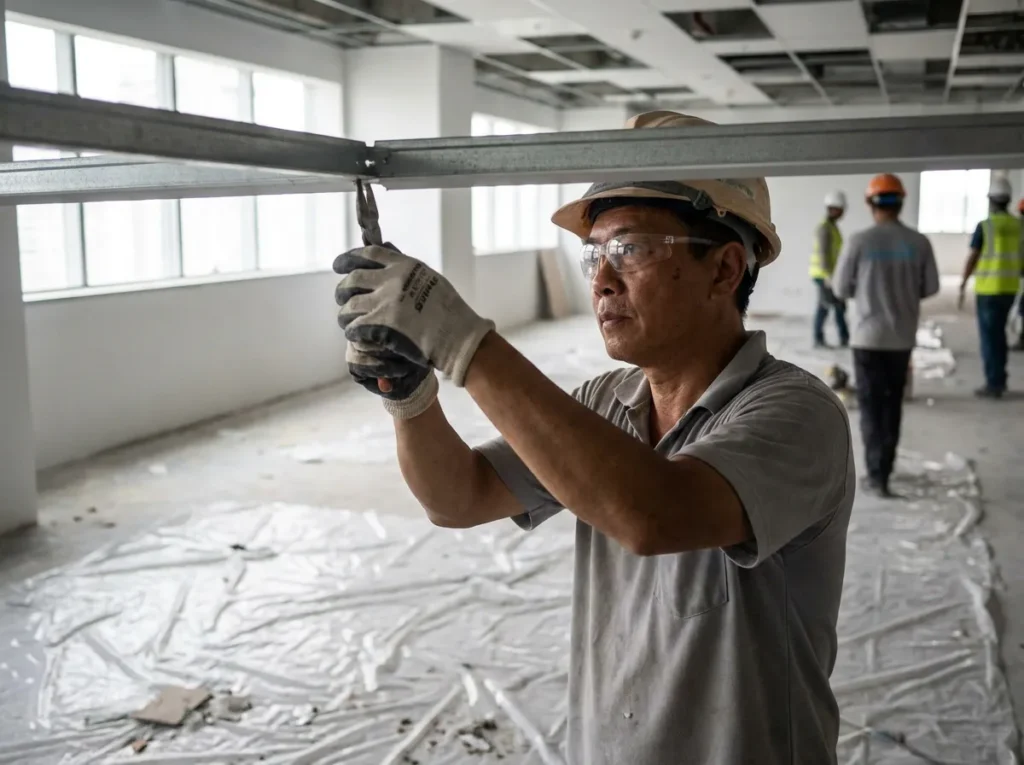
A full office reinstatement typically covers:
- Partition removal. Drywall, glass partitions and any built-in joinery or feature walls added during your tenancy.
- False ceiling removal. Ceiling boards, grid, and any bulkheads built around services.
- Flooring removal. Carpet, vinyl, raised access flooring, and the adhesive residue underneath, which is more work than most tenants expect.
- M&E disconnection. Lighting, power points, data trunking, and ACMV including any additional fan coil units or ductwork you installed.
- Hacking works. Where the unit has to go back to bare condition, including removing screeds, kerbs or structures added for a specific fit-out.
- Patching and repainting. Making good every wall, column and soffit to the specification the landlord will accept.
- Debris disposal and final clean. The unit has to be inspection-ready, not just empty.
Not every reinstatement includes every item. The scope is set by your clause, which is exactly why the clause should be read before anyone prices the job. A tenant who assumes bare shell when the lease only asks for removal of tenant additions can easily pay for work they were never obliged to do.
Who is responsible, and what happens if you get it wrong
Reinstatement is normally the tenant’s responsibility. The obligation sits with you under the lease, and it survives the last day of the tenancy in the sense that the landlord can recover the cost from you if the work is not done.
In practice the consequence arrives in one of three ways. The landlord deducts the cost of completing the works from your security deposit, which is usually the largest single sum at stake. Or you are charged holding-over rent for the period the unit remains unavailable while works continue past the expiry date, which can be charged at a premium to the normal rate. Or the joint inspection fails and you are sent back to redo items, which costs time you no longer have.
None of these are unusual. They are the standard commercial consequence of a handover that is not ready on the day, which is why the schedule matters as much as the workmanship.
When to start planning your reinstatement
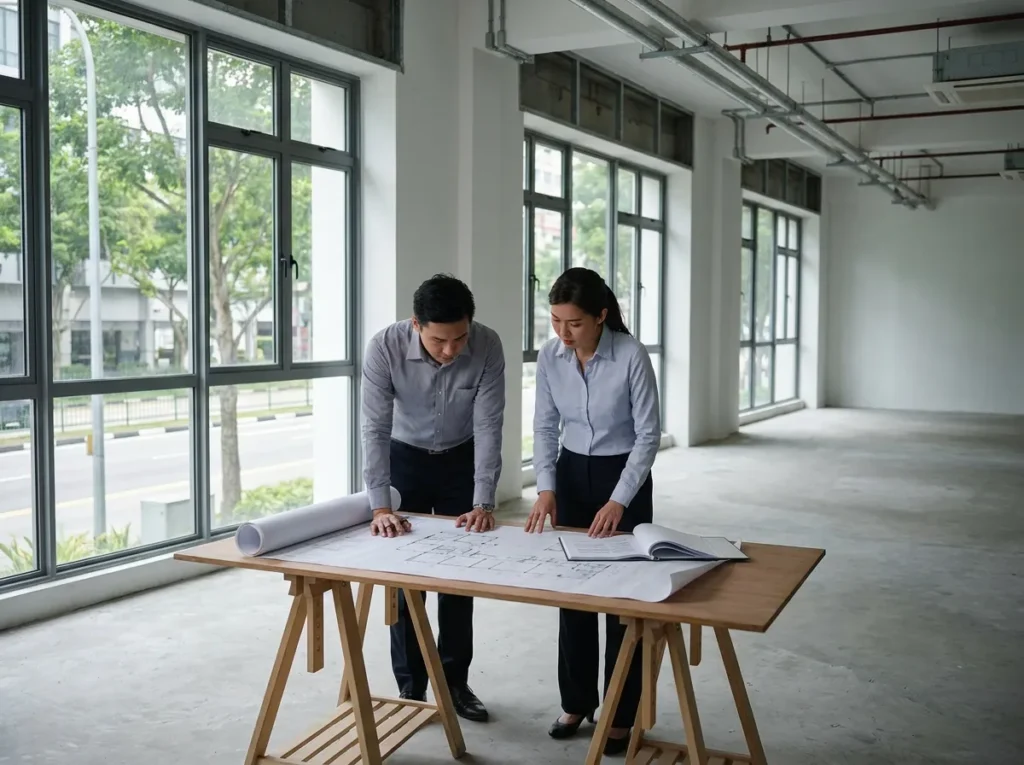
Most office reinstatement works take between three days and four weeks depending on the size of the unit and how much M&E has to come out. That is the works window only. It does not include reading the clause, agreeing the scope, obtaining landlord and building management approval, or booking permitted working hours with the MCST.
A sensible sequence is to read the reinstatement clause six to nine months before expiry, get the unit assessed and scoped around three months out, and have a contractor committed with an approved schedule at least six weeks before handover. Tenants who start at the four-week mark are usually the ones paying for weekend and after-hours work to make the date, and our full office handover checklist sets out the whole countdown.
Reinstatement cost in Singapore
Office reinstatement in Singapore generally runs at around S$10 to S$20 per square foot, or roughly S$100 to S$200 per square metre, to return a whole unit to its original condition. Where you sit in that range depends on the size of the unit, how much M&E and ACMV has to be disconnected, whether hacking works are involved, and the exact end state your landlord’s schedule specifies.
The largest single cost driver is not floor area. It is the end state. Removing tenant additions and repainting is a fundamentally different job from taking a fitted-out unit back to bare shell with services capped, and the gap between those two scopes is far wider than the gap between two contractors’ quotes for the same scope. Confirm the end state first, then compare prices on a like-for-like basis.
Reinstatement is not the same as renovation
It is worth separating these two, because tenants often plan them as one project and then discover they are on two different schedules with two different landlords.
Reinstatement looks backwards. It undoes a fit-out and returns a unit you are leaving. Office renovation and fit-out looks forwards. It builds out a space you are moving into. If you are relocating, you are running both at once: reinstating the old unit before its expiry date while fitting out the new one to an occupancy date. Those two dates rarely line up neatly, and the overlap is where double rent gets paid.
Running both with one contractor is usually the simpler arrangement, because a single team can sequence the strip-out and the build around each other rather than two firms each protecting their own schedule.
How Trends Interior handles reinstatement
Trends Interior has been a commercial contractor in Singapore since 2004 and we are BCA-registered. We are commercial only, so we do not take on residential or HDB work, and our reinstatement services cover offices, retail and shop units and warehouse and industrial spaces.
Electrical, drywall and partitioning, ACMV and carpentry are all our own in-house crews rather than subcontractors. On a reinstatement that matters more than it does on a build, because a strip-out is a sequence of trades handing over to each other in a short window. When those trades belong to different companies, a one-day slip in the first one pushes every stage behind it, and the date at the end of the sequence is a date that does not move.
Reinstatement is a deadline problem before it is a building problem
The reinstatement meaning is straightforward enough once you have read your clause. Return the unit in the condition your lease specifies, by the date it specifies. The difficulty is never the definition. It is that the date is fixed, the scope is set by someone else’s document, and the money at risk sits in a deposit the landlord is already holding.
Read the clause early, confirm the end state before you compare quotes, and give the works a realistic window rather than the minimum one. If your lease is approaching expiry, our office reinstatement team in Singapore can assess the unit against your handover schedule and scope the works to exactly what your landlord will sign off. Speak to us about your handover date and we will tell you honestly whether the timeline still works.
Facing a lease expiry? Book a free site assessment and we will read your reinstatement schedule with you before you commit to any scope.
Frequently Asked Questions About Office Reinstatement
What is the meaning of reinstatement in property?
Reinstatement in property means restoring a leased unit to the condition required by the tenancy agreement before it is handed back to the landlord. In Singapore commercial leases it is also called making good, and the required condition is set out in the reinstatement clause and the dilapidation schedule.
What does reinstatement work involve?
Reinstatement work involves removing partitions, false ceilings and flooring, disconnecting lighting, power and ACMV, carrying out any hacking works required, then patching, repainting, clearing debris and cleaning the unit so it is ready for a joint inspection.
Is reinstatement the tenant’s responsibility or the landlord’s?
Reinstatement is normally the tenant’s obligation under the lease. If the unit is not returned in the required condition, the landlord can complete the works and recover the cost, usually by deducting it from the security deposit.
How long does office reinstatement take in Singapore?
Most office reinstatement works take between three days and four weeks depending on the size of the unit and the amount of M&E to be removed. Approvals, scoping and building management submissions should be allowed for on top of the works window.
What is the difference between reinstatement and renovation?
Reinstatement undoes an existing fit-out and returns a unit you are leaving to its required condition. Renovation builds out a space you are moving into or continuing to occupy. Tenants who are relocating often need both at the same time.