
Quick answer: ACMV stands for Air-Conditioning and Mechanical Ventilation. It is the system that cools a building and moves air through it, covering chillers, air handling units, ductwork and fresh air supply. In Singapore, ACMV is the standard industry term for what many countries call HVAC.
If you have read a Singapore tender document, a tenancy handover schedule or a fit-out quotation, you have met the abbreviation ACMV. The ACMV meaning is straightforward: Air-Conditioning and Mechanical Ventilation. It covers everything that cools the air in a building and everything that moves air around it, from the chiller on the roof to the diffuser above your desk. The National Environment Agency uses the same term in its energy efficiency guidance, which is a good indication of how standard it is here.
What the abbreviation does not tell you is how much sits inside it, or why the distinction between the two halves matters when you are fitting out or handing back a commercial unit.
What ACMV stands for, and why Singapore uses the term
ACMV splits into two functions that are often installed together and are genuinely different jobs.
Air-conditioning controls temperature and humidity. In Singapore’s climate the humidity half matters as much as the cooling, because air that is cooled but not dehumidified feels clammy and causes condensation problems.
Mechanical ventilation moves air. It supplies fresh air into occupied spaces and extracts stale or contaminated air out of them, using fans and ductwork rather than relying on opening a window. A car park extract system, a toilet exhaust and a kitchen extract are all mechanical ventilation, and none of them cool anything.
The reason you see ACMV in Singapore rather than HVAC is partly climate and partly convention. Heating is essentially irrelevant here, so the H in HVAC describes something almost no local commercial building needs. The local term names what is actually installed.
ACMV vs HVAC: the difference explained
This is the most common question about the term, and the answer is less dramatic than it looks.
| Aspect | ACMV | HVAC |
|---|---|---|
| Stands for | Air-Conditioning and Mechanical Ventilation | Heating, Ventilation and Air-Conditioning |
| Used in | Singapore, Malaysia and much of Southeast Asia | United States, Europe, most international standards |
| Heating | Rarely included, the climate does not require it | Central to the definition |
| Emphasis | Cooling, dehumidification and air movement | Full year-round climate control |
| In practice | The same equipment families: chillers, AHUs, FCUs, ductwork | The same equipment families, plus heating plant |
They are not competing technologies. They are regional names for the same discipline, with the scope adjusted for climate. A chiller in Singapore and a chiller in London do the same thing; the London building also needs a boiler.
The practical implication is about documents, not hardware. If your lease, tender or handover schedule says ACMV, it means the cooling and ventilation installation as a whole, including the ventilation that does no cooling at all. Tenants sometimes read ACMV as “the air-con” and miss the extract and fresh air obligations sitting in the same line item.
What is inside an ACMV system
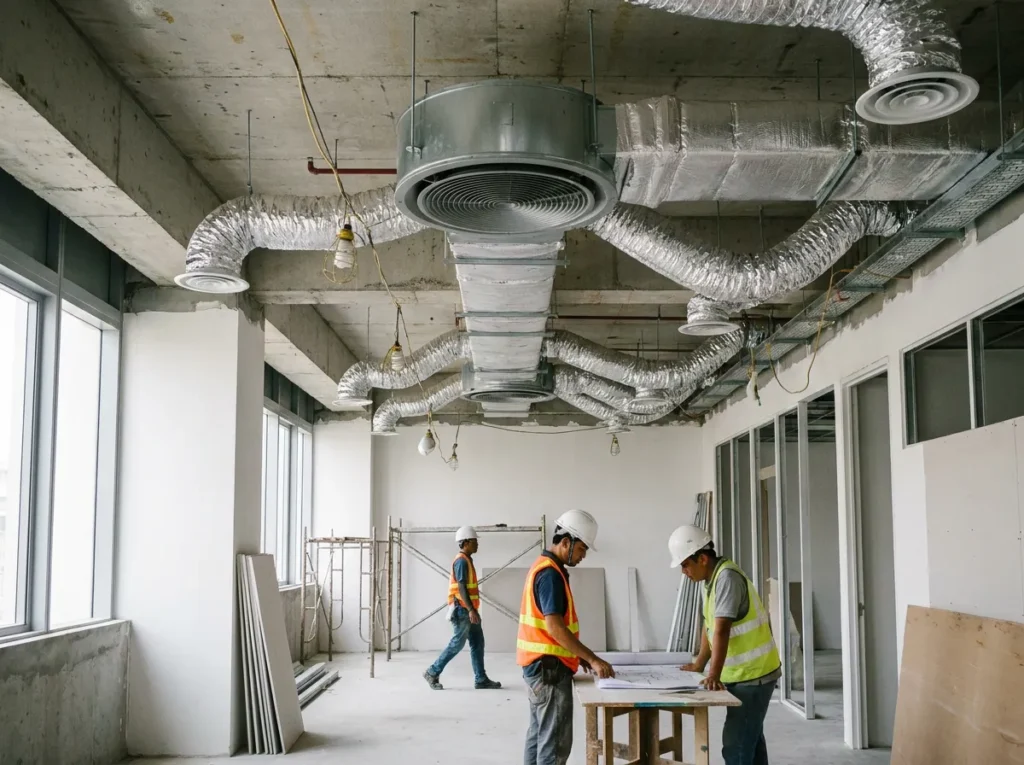
A commercial ACMV system is usually described in three parts.
Generation. The equipment that produces cooling. In a large building this is a chilled water system: chillers cool water, pumps circulate it, and cooling towers or condensers reject the heat. In smaller premises it is more likely a direct expansion system, where refrigerant does the work without a water loop.
Distribution. How cooling reaches the space. Air handling units and fan coil units take chilled water or refrigerant and use it to cool air, which then travels through ductwork to diffusers in the ceiling. This is the part a fit-out actually touches, because the ducts and diffusers have to follow the layout you are building.
Ventilation. Fresh air supply and extract. Fresh air is drawn in, often pre-treated, and delivered to occupied areas. Extract systems pull air out of toilets, car parks, kitchens and any space where air should not recirculate. This runs on its own fans and ducts and is easy to forget precisely because it is not what people mean when they say “the aircon”.
How a chilled water system works, briefly
Since chilled water system brings people to this topic on its own, it is worth walking the loop.
A chiller cools water to roughly 6 to 7 degrees Celsius. Pumps push that chilled water through insulated pipework to air handling units and fan coil units around the building. Each unit blows return air across a coil carrying the cold water, which cools and dehumidifies the air before it is ducted to the space. The water, now warmer, returns to the chiller to be cooled again. The heat collected along the way is rejected outside, through a cooling tower on a water-cooled system or through condensers on an air-cooled one.
The advantage over dozens of separate units is efficiency at scale and centralised maintenance. The trade-off is that it is a building-wide system, so a tenant fitting out one floor works within the capacity and the connection points the landlord provides rather than designing the system from scratch.
Where ACMV matters in a fit-out
For most commercial tenants ACMV becomes real at three moments.
When you fit out. Cooling has to be redistributed to the layout you are building. A meeting room where there was open plan needs its own supply and, ideally, its own control. Ductwork, diffusers and any additional fan coil units are coordinated at design stage, because they compete for ceiling void space with lighting, sprinklers and the ceiling itself. Resolving that after the ceiling design is fixed means something gets compromised on site.
When you occupy. Capacity, zoning and control determine whether the space is comfortable. The most common complaint in a finished office is not that cooling is absent but that it is unevenly distributed, which is usually a zoning decision made during design.
When you hand back. Reinstatement clauses commonly require added ACMV to be removed and the installation returned to its original condition, with services capped back where specified. Tenants who added fan coil units or reconfigured ductwork are normally the ones removing them. This is covered in more detail in our guide to what office reinstatement involves.
ACMV works and who is allowed to do them
“ACMV works” in a quotation usually means the supply, installation, modification or removal of any part of the above: equipment, ductwork, pipework, controls and commissioning.
Two points worth knowing. Work involving refrigerant handling and electrical connection must be carried out by appropriately qualified and licensed trades, which is a regulatory requirement rather than a quality preference. And ACMV interacts with fire safety, because ductwork crossing a fire compartment needs the correct treatment, and ventilation systems often have a defined role in a building’s smoke control strategy. Both are reasons ACMV design is coordinated rather than improvised.
Energy efficiency is the other live consideration. ACMV is among the largest energy consumers in a Singapore commercial building, which is why NEA publishes guidance on it and why it features heavily in BCA Green Mark assessments. Specific requirements should be confirmed against your building and your scope with the relevant authorities.
How Trends Interior handles ACMV
Trends Interior has worked on commercial projects in Singapore since 2004 and is commercial only. ACMV is one of our four in-house trades, alongside electrical, drywall and partitioning, and carpentry.
That matters most during coordination. On a fit-out, the ductwork, the lighting layout, the sprinkler positions, the ceiling design and the joinery all compete for the same space above the occupants’ heads. When those trades sit inside one team, the clashes are resolved in a drawing review instead of arriving as a variation halfway through the build. Our commercial electrical and ACMV work runs from design coordination through installation to commissioning, and the same crews handle removal and capping when a unit is being handed back.
ACMV is one line item hiding two different jobs
The ACMV meaning is easy. Air-Conditioning and Mechanical Ventilation, the Singapore term for what much of the world calls HVAC. What catches people out is that the second half is a separate job from the first. Cooling is what everyone notices. Ventilation is what quietly determines whether a space is compliant, comfortable and legal to occupy, and it is the half most often overlooked in a quotation or a handover schedule.
Read the term as covering both, and check which parts of the installation are the landlord’s and which are yours before you fit out or hand back. If you are planning a commercial project, our team handles ACMV and commercial M&E in Singapore with in-house crews and coordinates it against the rest of the build from day one. Send us your floor plan and scope and we will tell you what the ACMV side actually involves.
Planning a fit-out or a handover? Book a free site assessment and we will review the ACMV scope with you before anything is priced.
Frequently Asked Questions About ACMV
What does ACMV stand for?
ACMV stands for Air-Conditioning and Mechanical Ventilation. It covers both the equipment that cools and dehumidifies a building and the fans and ductwork that supply fresh air and extract stale air, and it is the standard industry term in Singapore.
What is the difference between ACMV and HVAC?
They describe the same discipline with the scope adjusted for climate. HVAC stands for Heating, Ventilation and Air-Conditioning and is used internationally. ACMV drops heating, which Singapore’s climate does not require, and is the common term locally. The equipment families are the same.
What is the role of an ACMV system in a building?
It maintains temperature and humidity in occupied spaces, supplies fresh air, and extracts stale or contaminated air from areas such as toilets, car parks and kitchens. In a Singapore commercial building it is among the largest consumers of energy.
What is a chilled water system?
A chiller cools water to around 6 to 7 degrees Celsius and pumps circulate it through insulated pipework to air handling and fan coil units. Those units blow air across a cold coil to cool and dehumidify it before it is ducted into the space, and the warmed water returns to the chiller.
Do I need to remove ACMV when I hand back a leased unit?
Usually yes for anything you added. Reinstatement clauses commonly require added fan coil units, ductwork and controls to be removed and the installation returned to its original condition, with services capped where the clause specifies. Check your own reinstatement clause and handover schedule.